By Jorge Ramirez, actively licensed New Jersey real estate salesperson #1754604. Licensure does not imply endorsement. Affiliated with NOTUDES ENTERPRISES LLC, a New Jersey real estate broker.
Oil Tank Sweep NJ: A Practical Guide for Home Buyers and Sellers
Heating systems change, owners move, and paperwork gets lost. A house may use natural gas today even though an earlier owner heated it with oil. That history does not automatically mean there is a buried tank or contamination. It does mean buyers and sellers should separate three different questions:
- Is there evidence that a tank exists or once existed?
- If a tank was removed or abandoned, what records document the work?
- If oil was released, was the site investigated, remediated, and formally closed?
This guide explains how to organize those questions. It is educational information—not legal advice, an environmental assessment, or a substitute for a licensed site professional.
What an Oil Tank Sweep Can—and Cannot—Tell You
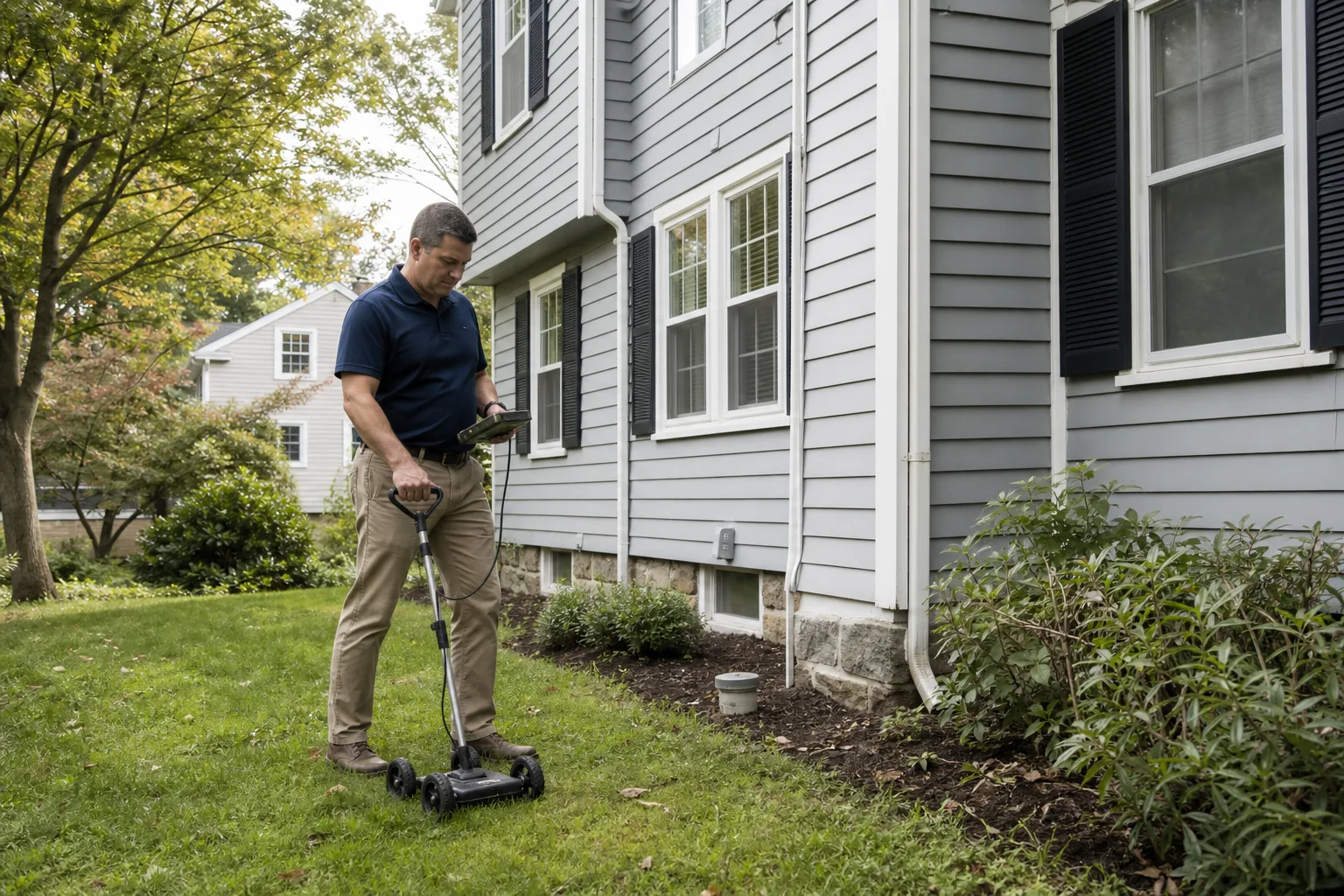
A tank-sweep company typically combines a visual review with subsurface detection equipment. The inspector may look for old fill or vent pipes, patched foundation penetrations, abandoned fuel lines, disturbed areas, and underground anomalies. The written report should say what methods were used, what areas were accessible, and what was found.
A sweep is useful evidence, but it has limits. An anomaly is not automatically a tank. A report that finds no anomaly does not certify that a prior tank was removed correctly, prove that soil is clean, or close an environmental case. Ask the inspection company to explain its scope, exclusions, equipment, insurance, and what happens if the result is inconclusive.
When Does NJDEP Require Action?
An oil-tank sweep is a private inspection and is not the same as an NJDEP-mandated remediation action. Whether a buyer performs a sweep is a transaction-specific due-diligence decision shaped by the contract and advice from the buyer's attorney and other qualified professionals, plus any lender, insurer, or municipal requirements.
NJDEP draws an important distinction between an underground heating-oil tank and a discharge from that tank. Its current Unregulated Heating Oil Tank FAQs state that, when there is no indication of a discharge, there is no state requirement to remove a previously abandoned residential underground heating-oil tank. NJDEP also notes that real estate professionals may still recommend removal before a home sale. A contract, lender, insurer, or local permit issue can create practical requirements even when state environmental rules do not mandate removal.
Start With Records Before You Start Digging
A clean paper trail can answer questions that a visual inspection cannot. Buyers should request available records; sellers should gather them before listing if the home's heating history is unclear.
- Municipal construction and fire records: permits for tank installation, abandonment, removal, fuel conversion, or related work.
- Seller records: invoices, closure permits, photographs, tank-removal reports, soil-sampling results, and correspondence from prior contractors.
- NJDEP records: case information, reports, and any No Further Action letter. NJDEP's UHOT guide directs homeowners to its records and Unregulated Heating Oil Tank program.
- Current inspection evidence: visible piping, a basement fuel line, an active aboveground tank, or unexplained patches may help the inspector decide where to focus.
Do not treat a municipal permit marked “closed” as proof that a contaminated-site matter was closed by NJDEP. Those are different systems. Match each document to the question it actually answers.
How to Read the Possible Outcomes
| Finding | What it means | Reasonable next question |
|---|---|---|
| No anomaly reported | The inspector did not detect a tank-like anomaly within the stated scope. | Were all relevant areas accessible, and do the municipal/NJDEP records agree? |
| Inconclusive anomaly | The equipment detected something that cannot be identified from the surface. | What additional investigation does the qualified inspector recommend? |
| Tank appears present | A buried object and/or physical evidence is consistent with a tank. | What does the contract require, and which certified contractor should evaluate closure options? |
| Prior removal records found | A tank was reportedly removed or closed. | Do the records include sampling and, if a discharge occurred, NJDEP closure documentation? |
| Discharge or contamination identified | The matter has moved beyond a sweep into environmental response. | Has NJDEP been notified, and who is overseeing investigation and remediation? |
If a Tank Must Be Closed or Removed
NJDEP says underground tank closure—whether removal or abandonment in place—must be performed by a contractor certified for underground storage tank closure under New Jersey's UST rules. The agency's homeowner guide explains how to verify certified firms and recommends getting multiple quotes with a clear description of included services.
Certification matters because tank closure and contaminated-soil remediation are different scopes. NJDEP explains that a closure contractor may perform remediation only if the contractor also has the appropriate subsurface-evaluation certification or is a Licensed Site Remediation Professional. Verify credentials for the work actually needed; do not assume one license covers every step.
What Happens if a Leak Is Discovered?
If a discharge is confirmed, it must be reported to NJDEP and investigated under the applicable rules. The NJDEP UHOT homeowner guide explains that the agency becomes involved when a confirmed discharge is reported and remediation is required. The owner then works with a properly certified subsurface evaluator or Licensed Site Remediation Professional to investigate and remediate the contamination. NJDEP's notices page lists July 21, 2025 as the publication date for the N.J.A.C. 7:26F readoption notice and December 15, 2025 as the publication date for the N.J.A.C. 7:14B readoption notice.
The facts control the scope. Soil sampling is part of the UHOT closure process, and groundwater or other conditions can require additional work. NJDEP's current program page describes the documentation submitted after remediation and the process for obtaining a No Further Action letter. Because conditions vary from property to property, avoid relying on a generic cleanup-cost estimate or a promise that every case follows the same timeline.
Sweep Report vs. No Further Action Letter
These documents are often confused, but they do different jobs:
- Tank-sweep report: records the private inspector's methods, observations, and detection results on a given date.
- Removal or closure documentation: records physical work performed on a tank and may include permits, photographs, disposal records, and sampling.
- NJDEP No Further Action letter: a final remediation document stating that no contaminants are present or that contamination from the discharge was remediated to the applicable standards. NJDEP says the NFA closes the heating-oil contamination issue.
If the file contains an NFA letter, verify that it belongs to the correct property and area of concern. If the seller has only a receipt or an old permit, ask what environmental conclusion—if any—that document supports.
Buyer Checklist for an Older NJ Home
- Ask what fuels the property has used and whether the seller knows of any current or former tank.
- Review municipal, seller, and available NJDEP records early enough to meet contract deadlines.
- Choose an insured inspection company and get the sweep scope in writing.
- Keep the full report, not just a text message saying “clear.”
- Send any anomaly, missing record, or prior-remediation document to your attorney and qualified environmental professional.
- Do not waive a contractual right or accept an environmental obligation based only on a verbal assurance.
Seller Checklist Before Listing
- Gather fuel-conversion, tank, permit, sampling, remediation, and NJDEP documents.
- Tell your attorney and listing agent what you know; do not guess or conceal known material facts.
- If records are missing, decide with qualified advisers whether to search records, sweep, or investigate before marketing.
- If a discharge is identified, follow NJDEP reporting and remediation requirements.
- Present documents in one organized file so buyers, attorneys, and lenders are reviewing the same evidence.
For a broader preparation plan, see the New Jersey seller disclosure guide and the guide to home-inspection red flags for NJ sellers. Buyers can also use the New Jersey first-time buyer guide to place inspection decisions in the full transaction timeline.
Frequently Asked Questions
Is an oil tank sweep required when buying a home in New Jersey?
An oil-tank sweep is a transaction-specific due-diligence decision, not the same as an NJDEP-mandated remediation action. Whether a buyer performs one depends on the contract and advice from the buyer's attorney and other qualified professionals, plus any lender, insurer, or municipal requirements. NJDEP's narrower guidance says there is no state requirement to remove a residential underground heating-oil tank when there is no indication of a discharge.
Can you sell a New Jersey home with an underground heating-oil tank?
NJDEP says there is no state requirement to remove a residential underground heating-oil tank when there is no indication of a discharge. A buyer, lender, insurer, municipality, or contract may still require additional investigation, removal, or documentation before closing.
Does a clean oil tank sweep replace an NJDEP No Further Action letter?
No. A sweep report documents what the inspection company observed or detected. An NJDEP No Further Action letter is a final remediation document for a contamination case and confirms that the discharge issue has been closed under the applicable standards.
What happens if a heating-oil leak is found in New Jersey?
A confirmed discharge must be reported to NJDEP, and the owner should work with properly certified environmental professionals. Investigation, sampling, cleanup, and NJDEP closure documentation may be required. Do not rely on a general real estate article for a site-specific cleanup plan.
Primary Sources
Checked August 17, 2026. Rules, forms, fees, and program procedures can change; verify the current NJDEP page before acting.
- NJDEP: Homeowner's Guide to the Unregulated Heating Oil Tank Program
- NJDEP: Unregulated Heating Oil Tank FAQs
- NJDEP: Site Remediation Forms Library
- NJDEP: Current Site Remediation Rules
- NJDEP: Notices of Readoption
Buying or Selling an Older Home in North or Central Jersey?
I can help you organize the real-estate side of the transaction and coordinate the right questions with your attorney and environmental professionals. I do not perform tank sweeps or environmental remediation, and I will not minimize a finding to keep a deal moving.
Jorge Ramirez · NJ real estate salesperson #1754604. Licensure does not imply endorsement.
NOTUDES ENTERPRISES LLC, a New Jersey real estate broker · Keller Williams Realty Premier Properties of Summit · 488 Springfield Avenue, Summit, NJ 07901
Disclosure: Jorge Ramirez is an actively licensed New Jersey real estate salesperson (#1754604). Licensure does not imply endorsement. His affiliated broker is NOTUDES ENTERPRISES LLC, a New Jersey real estate broker, doing business as Keller Williams Realty Premier Properties of Summit. Brokerage office: 908-273-2991. Direct: 908-230-7844. Each office is independently owned and operated. This article provides general educational information and is not legal, environmental, engineering, insurance, lending, or tax advice. Consult the appropriate licensed professionals for your property and contract.